
How to Choose an Amphibious Excavator — Pontoon, Ground Pressure & Displacement Guide

Industry News

2026/11/06
Standard tracks sink in mud. A normal excavator can dig a trench on firm ground, but it cannot enter a flooded paddy, a tidal flat, or a riverbank that is still holding water.
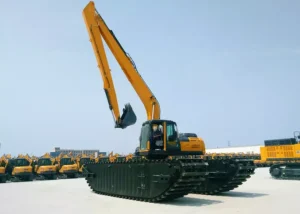
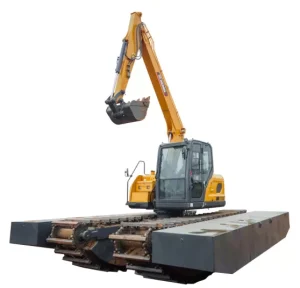
That gap is what an Amphibious Excavator closes. A pontoon chassis spreads the machine weight over a large waterline. The result is low ground pressure and the ability to work in water, mud, and soft soil that would trap a standard unit.
The problem is that buyers usually look at boom length first. The wrong pontoon size, low displacement margin, or a shallow-water design forced into deep work all lead to the same result: the machine sits in the water doing nothing.
This guide covers pontoon sizing, ground pressure, and displacement. It also lists the applications where an amphibious unit earns its cost, and how to check a supplier’s spec sheet before you order.
How an Amphibious Excavator Works
An amphibious excavator is a standard machine on a special undercarriage. The tracks are replaced, or wrapped, by a sealed pontoon structure. Some designs use a multi-hull catamaran-style float, while others use a single sealed box frame.
Three things change with that undercarriage:
- Contact area. The pontoon spreads machine weight across a much wider area than standard tracks.
- Sealed structure. The box-shaped track segments keep water and mud out of the undercarriage.
- Hull form. The pontoon shape lets the machine float and self-propel in shallow water instead of sinking.
The upper structure — engine, hydraulic system, boom, arm, and bucket — is close to a standard excavator. Some models add an extended boom for deeper digging. The key difference is the platform, not the dig.
This matters for one reason: an amphibious excavator is a land machine first and a water machine second. On firm ground, a normal excavator is faster and cheaper to run. On soft ground and in water, the standard machine cannot even reach the job.
How to Size the Pontoon
A worked example helps:
| Item | Value |
|---|---|
| Machine operating weight | 20,000 kg |
| Total pontoon contact area | 12 m² |
| Resulting ground pressure | about 1,700 Pa |
| Typical soft mud bearing capacity | 2,000–3,000 Pa |
| Firm land bearing capacity | 30,000+ Pa |
On firm land, 1,700 Pa is nothing. A normal excavator runs at 30,000 to 50,000 Pa and still moves. In soft mud, 1,700 Pa sits below the typical bearing limit, so the machine floats on the surface instead of sinking.
That is the whole point of the pontoon. It is not about looking different. It is about staying under the ground pressure limit where the job actually is.
When you compare two pontoon designs, ask three questions:
- What is the total contact area in square meters, with the machine at operating weight?
- Is the pontoon fully sealed, or does it have open sections that take water?
- Does the supplier state a rated ground pressure or a test record in mud?
A supplier that gives you a weight and a bucket size but not a contact area is not ready for your project.
How Displacement Decides Water Depth
Displacement is the second number that controls what the machine can do. It is the volume of water the pontoon can push aside before it sits at the waterline.
The practical rule from the industry: standard amphibious excavators are designed for water depth of about 1.0 m or less. Above that, the manufacturer must do specific structural work to raise the hull, add flotation, or change the track seal design.
This is not a small detail. A standard 20-ton amphibious unit that is asked to work in 2 m of water without a deeper-water package will:
- Take water into the pontoon seam lines
- Lose stability as the hull rides low
- Shorten service life of the undercarriage seals
Before you order, match the pontoon package to the deepest water you expect to work in. If the site has seasonal flooding, plan for the high-water case, not the dry-season case.
Two more displacement checks:
- Total loaded displacement, with an extended boom and a wet bucket
- Freeboard margin in that loaded condition
Top Applications
River and Canal Dredging
This is the highest-volume use. The machine clears silt, weeds, and debris from urban canals, rural ditches, and drainage lines. An extended boom pushes the digging deeper than a standard unit can reach. The pontoon keeps the machine on the soft bottom instead of pulling it from a bank.
Dam, Levee, and Reservoir Work
Pre-flood slope trimming, riprap placement, cofferdam building, and seepage point sealing all need a machine that can stand in water or on a saturated toe. A pontoon chassis does not collapse on the soft shoulder the way standard tracks do.
Aquaculture Ponds
Old fish ponds and shrimp ponds get re-dredged and re-leveled without draining. The machine works in the water, opens new inlets and outlets, and raises pond walls. Work time drops sharply because there is no dewatering step.
Tidal Flats and Coastal Work
Coastal reclamation, seawall prep, and tidal-zone earthwork all run on soft ground that shifts with the tide. A standard unit gets stuck in the mud after the first hour. The pontoon version can walk in at low tide and still work the zone that is already wet.
Farmland and Irrigation
Paddy field drainage, low-lying land leveling, and farm waterway digging are classic uses. After a rain, the field is soft enough to stop a normal excavator, but the amphibious unit moves in and works the main and branch channels.
Urban Water Environment
Black-odorous water remediation, retention basin excavation, sponge-city earthwork, and underground box-culvert cleaning all fit. The machine can work underwater without dewatering the site.
Flood Response
Flooded-road clearing, debris removal, and emergency cofferdam placement are the emergency-use cases. The unit self-propels in shallow water to reach the spot and starts work without waiting for access roads to dry.
Land Performance vs Water Performance
An amphibious excavator is not a faster land machine. On firm ground, it is usually slower to move and has less digging force than a standard excavator of the same weight class. The design trade is built in.
That trade is the reason to think in job mix, not in machine specs:
- If 70% or more of your work is in water or soft ground, an amphibious unit is the right buy
- If the work is 80% land, a standard excavator plus a transport plan is cheaper overall
- If the job moves between zones, plan the move carefully. A pontoon unit should be craned or hauled between sites, not driven on hard road for long runs
The boom extension is where the real digging value sits. A long-reach boom on a pontoon base lets the machine clear deeper channels without moving the hull. Check the boom spec for the extended model, not the standard one.
What to Check Before You Buy
Spec Sheet Items
Ask for these numbers on every offer:
- Operating weight and total pontoon contact area
- Rated ground pressure or a mud-test record
- Rated water depth, and whether it is a standard or special package
- Freeboard in the loaded condition
- Boom length on the extended model
- Bucket options: standard dig, dredge, and clean-up buckets
Build Quality Items
Check the physical build:
- Pontoon weld quality and seam sealing
- Track box segment design and drain points
- Corrosion protection on all underwater parts
- Hydraulic hose routing, protected from mud and water spray
Service and Support Items
The undercarriage is the part that wears fastest in this class. Confirm:
- Local dealer or service point that knows pontoon machines
- Availability of track segment and seal parts
- Warranty terms that cover the undercarriage
- A working video on mud and in water, not just on firm ground
Work With MachPlaza
Send these items for a matched quote:
- Deepest water you expect to work in
- Typical ground condition: mud, silt, firm bottom
- Main task: dredging, leveling, demolition, or clearing
- Target market for parts and service
- New or used budget range
We will point out if a standard excavator covers the job and save you money. No pressure, no upsell.
For used units, we also check pontoon weld condition, seal wear, and hour readings on the undercarriage, which is the part that ages fastest in this class.
The quote comes with the data sheet, so you can compare pontoon contact area, rated water depth, and boom reach side by side. If your site conditions change between seasons, we will say whether the same unit still covers the wet months or whether a deeper-water package is the right move.
The Bottom Line
An Amphibious Excavator earns its place when the site is wet, soft, or flooded. The pontoon is the core of the design. Size it by contact area, check ground pressure against the mud you will actually work in, and match displacement to the deepest water you expect.
A standard unit is faster on land. An amphibious unit is the only one that reaches the job in water.
Before you order, get the spec sheet with contact area, rated water depth, and a mud-test record. Then buy the machine that fits the site, not the one with the longest boom.
One more point: plan the move. An amphibious unit should be craned or hauled between sites, not driven on hard road for long runs. If your fleet already runs a standard excavator on the land side of the same project, the pontoon unit only needs to cover the wet zone, and the combined setup stays cheaper than buying a second full machine.
FAQs
Q1: What is an amphibious excavator used for?
River dredging, pond rework, wetland clearing, paddy drainage, and flood response. Any job where standard tracks sink.
Q2: How deep in water can it work?
Standard units are designed for about 1.0 m or less. Deeper work needs a special hull package from the maker.
Q3: Can it move on firm ground?
Yes, but slowly. On hard ground a standard excavator is faster. Plan to crane or haul the amphibious unit between sites.
Q4: What is pontoon ground pressure?
Machine weight divided by pontoon contact area. It must sit below the mud’s bearing limit, typically 2,000–3,000 Pa for soft ground.
Q5: How is displacement different from ground pressure?
Ground pressure decides if it sinks in mud. Displacement decides how much water the pontoon can push aside in the loaded condition.
Q6: Do I need an extended boom?
If you are clearing channels deeper than the standard reach, yes. The extended boom is where most of the digging value sits.
Q7: What bucket should I use?
A standard dig bucket for earthwork, a dredge bucket for silt, and a clean-up bucket for fine material. Match the bucket to the main task.
Q8: How often does the undercarriage need service?
More often than a standard machine. Check seals, drain points, and track boxes on a set schedule, and inspect after every water job.
Q9: What should I inspect on a used unit?
Pontoon welds, seal wear, corrosion on underwater parts, hose routing, and hour readings on the undercarriage.
Q10: Where can I compare pontoon options?
Send your site depth, ground condition, and task list to MachPlaza. We will quote the matching unit and say if a standard excavator covers it instead.
