
Stationary vs Mobile Concrete Batching Plant — Fixed Output or Site Flexibility?

Industry News

2026/11/06
A road crew in one province asked us the same thing twice. “Is a mobile plant worth it, or should we pour a base and forget it?” Both answers were yes. Just not for the same job.
The real gap between a stationary concrete batching plant and a mobile concrete batching plant is not mixing power. Both use twin-shaft mixers. Both can hit C40 or higher. The gap is how the machine reaches your site and how it stands up once it lands.
A stationary plant is built at the site. Batching machine, inclined belt or bucket elevator, main tower, cement silos, screw conveyors, weigh hoppers and control room arrive as separate loads. You cast reinforced concrete foundations for each part. Then cranes lift, align and wire everything. That base is permanent. Nobody plans to move it.
A mobile plant arrives pre-built. Batching machine, mixer, weighing system and control cabinet sit on one steel frame or a trailer chassis. The maker assembles and test-runs it in the factory. On site you level the ground, set legs or strip footings, connect power and air lines, calibrate scales, then pour. Some crews run the same plant through three sites in one year.
So read it this way. A stationary plant means building a plant at a site. A mobile plant means towing a plant to a site.
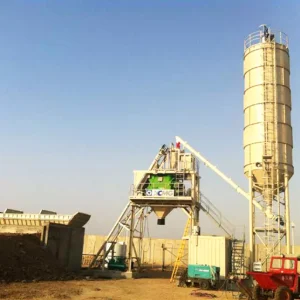
Where a stationary plant earns its base
If you stay put and pour a lot, nothing cheap beats a fixed line.
Output and steady running
Fixed towers carry bigger bins and larger hoppers. Loading does not stall the mixer. Parts run in a 24-hour cycle without overheating. HZS180 units with a JS3000 mixer feed proper ready-mix operations. HZS120 with JS2000 covers big precast work. An HZS90 with a JS1500 mixer stays the most common mid-size choice, and its stable output often lands near 65 to 75 m³ per hour.
Silo capacity helps too. Bigger cement storage means fewer refill waits. Wide stockyard space lets wheel loaders feed on their own schedule.
Control, dust, and acceptance checks
A fixed site has room for dust collection on the mixer itself, closed sheds over the aggregates, spray lines, wash water recycling and settling tanks. That matters where an environmental review must pass before you pour a single cubic metre. PLC control with saved batch records is standard on this class. Precast yards and ready-mix sellers need those records anyway.
Unit cost per cubic metre drops as volume climbs. Over two years of steady work, the base and steel pay back.
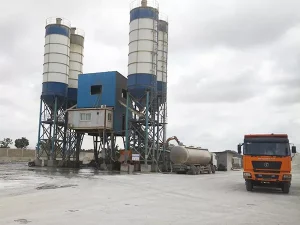
Where a mobile plant pays you back
A mobile plant wins on movement, not on raw tonnage. You buy it to follow the work, and to avoid pouring concrete you will later break up. Two job shapes fit it well.
Linear jobs push the plant forward
Highways, railways, canals and pipeline work move along an alignment. A fixed plant forces one of two bad options: build several fixed plants along the route, or haul concrete too far. Ready-mix holds quality best inside 10 to 15 km. Past that, slump drops, setting starts early, and the truck bill climbs. One mobile plant relocated two or three times beats two fixed plants in most cases.
Short schedule and borrowed land
A fixed plant’s foundations, stockyard walls and loading ramp cost real time and money. When a job ends in a few months, nobody absorbs that. Mobile units land on compacted, hardened ground. Setup runs in days. Demobilisation runs just as fast.
Rented urban plots, mountain corridors and live factory yards often cannot host permanent foundations at all. A mobile unit takes less ground and asks less of it.
The output number most buyers get wrong
The model number is a theoretical hourly rate. Honest planning uses about 70% of it, and 0.7 to 0.8 is the normal band.
Size from your peak day, not your average day:
Required hourly output = biggest daily pour ÷ working hours per day ÷ 0.7Add a 15 to 20% margin on top. Then compare with what mobile frames actually deliver. On a single shift of 8 hours with 6.5 to 7 hours of real running, a YHZS50 mobile unit gives roughly 35 to 40 m³ per hour, or 230 to 280 m³ a day. A YHZS75 gives about 55 to 60 m³ per hour, or 360 to 420 m³ a day. Daily demand above 500 m³ generally breaks the mobile case. Daily demand of 200 to 300 m³ needs no more than a YHZS50 or YHZS60, so do not buy bigger to feel safe.
Mobile frames are common from 25 to 75 m³ per hour. Push a 90 into a towed frame and the machine splits into more modules, which eats the speed advantage you bought it for.
These figures are typical planning ranges. Confirm the rating of any specific build against its mixer model, belt and bin sizes.
Cost: the base, the moves, and the quiet items
Three ledgers decide this choice, and most buyers read only the first.
Foundations
A fixed plant needs separate reinforced foundations for tower, batching machine, silos and belts, plus stockyard walls and a ramp. Civil work sits heavy in both budget and schedule. A mobile plant needs a level, hardened surface and a few strip footings or steel pad plates. That civil bill is often one order of magnitude smaller.
Relocation
Moving a mobile unit still means work. Belts, screws and silos come apart. Cables and air lines come off. Over-width transport permits apply in many regions. Plan a few days, not a morning. Still, relocation is counted in days. Moving a fixed plant is a teardown plus new foundations plus a fresh alignment and calibration, counted in weeks or months. Add the idle production in between.
The quiet items
Write these down before you compare quotes: haulage beyond the economic radius, site levelling, downtime during each move, dust and waste handling, plus wear-part stock. A low machine price fades next to those. Also clear the quote type. A bare frame, a full set, and an all-in landed price are three different numbers. Cement silos, screws, dust collection, freight and installation often get added later.
Three limits of a mobile plant
Buy it knowing what you give up.
Aggregate bins stay small. Mobile frames usually hold 3 or 4 compartments. A job needing five aggregate types, say two gravels and two sands, means a loader shuffling material and losing pace. Fixed batching machines handle 4 or 5 bins, and each bin is bigger. The PLD2400 four-bin unit pairs with most HZS90 and larger builds.
Space for service work is tight. Everything sits close together, so check the mixer access door and the direction each hopper opens before you order. Discovering a blocked bolt during a parts change is a bad day.
Capacity has a ceiling. Integrated frames limit bin size and mixer scale, which caps long-run output. A fixed tower still owns the heavy 24-hour work.
Wear shows up sooner on a frame that moves. Pin holes, leg pads, hinges and cable sockets take the stress of each setup. Ask how many relocations the builder rates the frame for, and what those parts cost after ten moves.
A middle choice: foundation-free plants
Some jobs sit between the two cases. A foundation-free plant carries a counterweighted steel base. You compact and harden the ground, then set it. No cast foundations. Dismantling goes faster than a traditional tower. Such units reach HZS90 or HZS120, so output stays well above most towed frames.
Two trade-offs. Purchase price runs above a standard fixed plant of equal spec. Long non-stop running is steadier on a true fixed base. For a 6 to 12 month job with one planned relocation, this middle class often fits best.
Buyers who suit it tend to look alike. A contractor holds two or three successive projects in one region, each lasting a season. A precast yard needs more output than a towed frame gives, but the land lease is short. A plant hire firm wants resale value after several contracts. In each case you keep most of the fixed plant’s output while skipping the civil work that locks a tower in place.
Ask three things before you order one. How the base transfers load to your ground, since soft fill still needs compaction. How long a real relocation took for the last customer, in days rather than hours. And whether the weighing system keeps calibration after a move, or needs a full recalibration each time.
What to check before you sign
Work the list in order. The first item decides the rest.
Size from peak output first. Then fix the type from schedule and land: mobile for a linear job under six months on borrowed land, fixed for owned land and two years of work, foundation-free in between. Then count aggregate types, since bins are hard to add later. Then inspect the heart of the machine, the mixer. Twin-shaft units use JS500 up to JS3000, where the number is discharge volume. Check liner thickness, blades, shaft-end seals and the gearbox. Thin liners on a cheap frame mean stops for changes, and downtime costs more than the savings.
Then check weighing. Four separate hoppers for aggregate, cement, water and admixture beat shared cells. Brand load sensors hold calibration better. Weak sensors drift, and drift means failed strength. Ask for full PLC control with stored batch data if you sell concrete or cast parts.
Then match the site: total installed power against your transformer, discharge height against your trucks (3.8 m suits standard agitators), and footprint against the plot. An HZS90 set needs roughly 300 to 500 m², plus stockyard and settling space. Ask what the local environmental review requires, then price dust collection once rather than twice.
Finally, ask who built it. A workshop you can visit and a machine you can watch run before shipping beats a trading name with no floor.
FAQs
Is a mobile plant really cheaper?
Lower to buy and cheap to install, but cost per cubic metre runs higher. Judge it on total spend across your real schedule and haul distance.
How long does a fixed plant take to build?
Foundations, assembly and calibration usually take weeks, not days. Cold weather and wet ground add time.
Which one suits a highway job?
Use mobile units on remote sections and short work camps. Fixed towers suit the main line where you pour heavy volumes for months.
Can a mobile plant mix high-strength concrete?
Yes. Fit a strong mixer and accurate weighing, and high-grade or special mixes are fine.
How far can ready-mix travel?
Keep it inside 10 to 15 km. Longer trips hurt workability and start setting early.
Can I run a ready-mix business from a mobile unit?
For short-term supply, yes. For years of steady orders, a fixed plant wins on cost and capacity.
What about relocation time?
Budget a few days for teardown, permits, transport and re-calibration. It is fast, but not same-day.
How do I pick the right capacity?
Take your biggest daily pour, divide by working hours, divide by 0.7, then add 15 to 20%. That number sets the model.
The bottom line
Neither machine is the good one. Fit is the test.
Choose a stationary concrete batching plant when the land is yours, the schedule runs past a year, daily demand sits above 500 m³, aggregate types stack up, or the environmental file must pass review. Choose a mobile concrete batching plant when the job moves, the schedule stays under six months, land is rented or tight, demand sits under 300 m³ a day, or remote haulage would eat your margin. Look at foundation-free units when you fall between those lines.
Judge the choice on full life cost — machine, civil work, moves, downtime, dust gear, wear parts. Do not start from a quotation number and work backwards.
That is where we can help. MachPlaza lists concrete batch plants and related equipment from makers such as XCMG, Zoomlion, SANY and Shantui. Send your peak daily volume, schedule, plot size, aggregate types and local environmental rules. We map the type and model to that data, then quote a full set rather than a bare frame. Browse the Concrete Mixing Plant range, the wider Concrete Machinery line, or the Concrete Solution page, then request a quote with your figures.
